
Stow Maries Great War Aerodrome is delighted to receive the gift of a World War One bomber propeller from Wilkin & Sons in Tiptree.
The hand-carved mahogany propeller was originally gifted to the famous Tiptree jam maker in 1919 by airmen at Stow Maries, when the aerodrome was being decommissioned. Now, over a century later, it is returning home to take pride of place in Stow Maries Great War Aerodrome’s Engine Workshop building, now home to an award-winning exhibition.
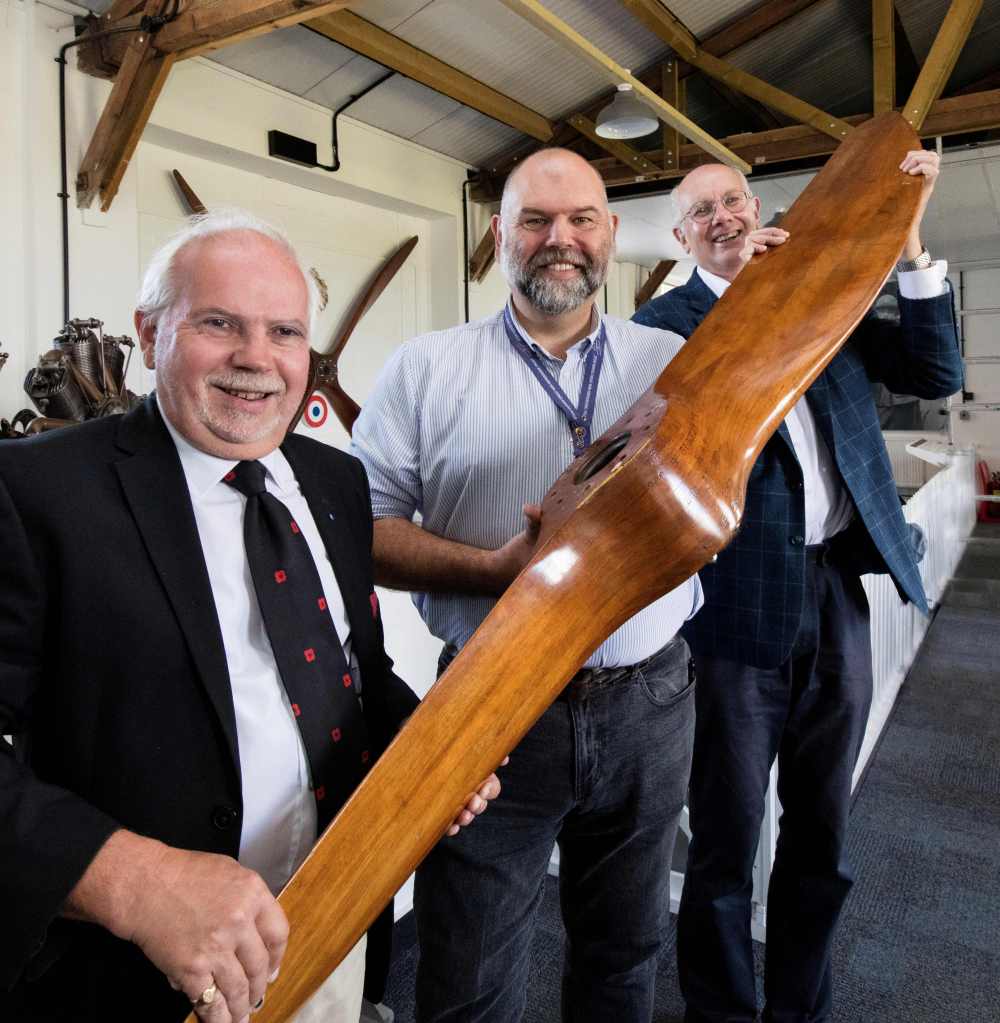
Nick Wickenden, Tiptree Jam Museum curator. Photo by David Davies
The Aerodrome has a long relationship with Wilkin & Sons, which received its first Royal Warrant back in 1911. In WW1, when Royal Flying Corps pilots at Stow Maries were defending the country from Zeppelins and Gotha bombers, having a bit of strawberry jam on their toast at the end of the day was considered vital to morale. So vital, in fact, that when supplies were running low, the pilots had a cunning method of making sure that there was jam tomorrow – they air-dropped a note!
At both Stow Maries and Tiptree Jam Museum, visitors can see an original examples of the colourful message streamers for these fruity missions, including one dropped on the factory from a BE2E aircraft, flown by the famous 2nd Lieutenant Milburn of 37 Sqn, RFC. The to-the-point message simply read: “Send more jam”. It’s likely that it was this friendly relationship between the jam makers and the airmen that led to the twin-bladed propeller being donated to Wilkin & Sons by 37 Squadron when they left Stow Maries in March 1919. What is less certain, however, is how the propeller ended up at Stow Maries in the first place.
Research by Museum Ambassador and local historian Stephen Nunn has identified it from the serial and batch numbers as being from an Airco de Havilland 9A – a single-engine light bomber that only entered service shortly before the end of World War One. However, it’s an aircraft that was never actually based at Stow Maries. “The mystery remains as to why a DH9A propeller found its way to Stow Maries in the first place. Was it, perhaps, attached to a visiting aircraft? Could it have been a souvenir that the Squadron “acquired” and then passed on? Or was it delivered in error, and they actually ordered one for a DH4, or F2b? We might never know for sure,” he says, “but it is certainly a coup for the Stow Maries collection.”
Ian Flint, Chief Executive Officer of Stow Maries Great War Aerodrome, comments: “This wonderful gift cements a relationship that has been fruitful for over a century. Tiptree preserves were a favourite of 37 Squadron back in 1916 – and are still enjoyed in The Airmen’s Mess café today. We are very grateful to the Wilkins Board for agreeing to donate this splendid object to Stow Maries Great War Aerodrome, completing the latest chapter in this fascinating mystery story.”
Nick Wickenden, Museum Curator at Wilkin & Sons, comments: ““Wilkin & Sons is delighted to transfer this beautiful wooden propeller back to Stow Maries Great War Aerodrome, just over a century after 37 Squadron gifted it to Tiptree. We know that Stow Maries will look after this, and it will fit perfectly into the Word War One displays and setting there.”
You can see the propeller in its new home at Stow Maries Great War Aerodrome, Hackman’s Lane, Purleigh CM3 6RN. Normal opening hours are Friday, Saturday and Sunday, 10am to 4pm. See www.stowmaries.org.uk for more information.
Discover more from Museums Essex
Subscribe to get the latest posts sent to your email.
 Museums Essex